Beauty in nature exists in the green leaves and coloured flowers
wonderfully arranged on the plants. We may see people around us
who study plants with interest, passion, love, enthusiasm or dedication towards environment. Many farmers do experiments on their crops and know more about plants than anybody else. Tribals living in forests know better about many herbs and their medicinal importance than a professional in Botany knows.
It is a known fact that science of plants (Botany) started with evolution of man but plants existed on this planet even before the evolution of man. One cannot imagine the life on earth without plants. No oxygen, no food, no sinks for carbon dioxide. Life can be miserable without these wonderful beings. If we once close our eyes and imagine the planet without plants we certainly feel suffocating. Life on this planet is beautifully twined around plants. And to study about science of plants is a blessing to students of Bi.P.C. Our surroundings unfold so many facts about plants if a student has a keen eye of observation. This makes learning Botany more simple and easy.
But in view of preparation for exams the student of Botany should know certain tips for scoring better. She/ he should master the skills of observation, application and analysis of the syllabus, drawing diagrams, knowledge about the type of questions asked, mode of preparation, presentation in the examination etc.. Though the method of preparation for IPE (Intermediate Public Examination -2018), EAMCET, NEET, JIPMER, AIIMS etc differ in terms of type and number of questions, the student should have basic understanding of the content and concepts in each chapter. A thorough review of the textbook as many times as possible, preparing synopsis and key notes for each chapter helps the students.
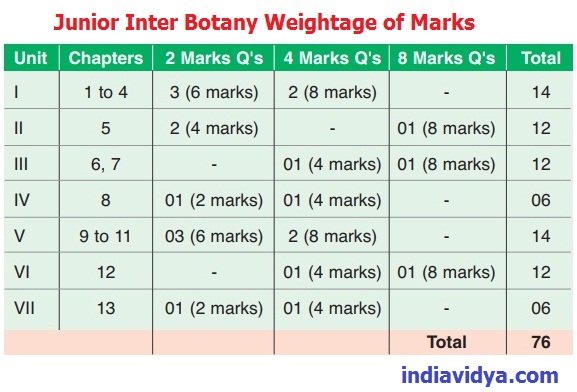
Here are a few guidelines for the students of Botany appearing for IPE March 2018. The syllabus in Junior Inter Botany comprises of 13
chapters under Seven Units. All chapters are equally important for study though the weightage given to each chapter in terms of number
of questions and marks varies. Though a number of study materials, guides, solved papers etc. are available in the market a thorough study of the text book between lines and words in each chapter is very important to secure high scores in IPE, NEET, EAMCET and other related examinations.
A review of the previous question papers in Intermediate Public Examinations gives us an idea of the type of questions, marks allotted to each chapter and weightage to each unit. Given below is the table of weightage drawn from a study of the previous model papers in Botany. It may vary according to the guidelines of the Intermediate Board with respect to weightage to each unit. The table given under here is only for an analysis and comprehension of the model of IPE question paper.
I. Diversity in the living world
The first unit in the syllabus Diversity in the living world comprises of 4 chapters. The basic concepts of biology, diversity in living world, Whittaker’s five kingdom classification of living organisms, importance and scope of Botany, branches of Botany, detailed study of plant kingdom etc. are discussed in these chapters. There are nearly 48 very short answer type questions in these chapters. The student can split these into 5 assignments and practice answering them. Regarding short answer type questions (4 Marks) the student may go through the important contents like tools of classification, binomial nomenclature, characters of euglenoids, chrysophytes, dinoflagellates, economic importance of algae, fungi and bryophytes, differences between red algae and brown algae, scope of Botany in agriculture, horticulture and medicine etc.
II. Structural Organisation in plants – Morphology
This chapter mainly deals with morphology and modifications of stem, root, leaf, inflorescence, flower and fruit. This is very interesting and important both in terms of theory and practical
examinations. Many of the examples mentioned in the text book are available in our surrounding. A keen observation of plants helps in
understanding the concepts clearly. Nearly 24 very short answer type questions are given under this chapter. All these questions should be repeatedly revised as there is a scope of getting two questions from these 24 questions. Types of root modifications, stem modifications and types of racemose inflorescences should
be studied for long answer type questions. A continuous practice of drawing diagrams of various modifications and other floral parts is
required to score high in this chapter.
III. Reproduction in Plants
The two chapters under this unit deal with modes of reproduction
starting from lower forms like algae, fungi to angiosperms and
gymnosperms. Chapter 7 gives a comprehensive account of sexual reproduction in flowering plants, the microsporogenesis, megasporogenesis, male gametophytes, female gametophytes (embryo sac), pollination types and agents, fertilization etc. Differences between asexual reproduction and vegetative reproduction, post fertilization changes, entry of pollen tube into the ovule, bagging, emasculation, triple fusion and double fertilization concepts are to be studied in depth for proper comprehension. Short answer and long answer type questions are important from this unit. Post fertilization changes, structure of embryo sac, microsporangium and process of fertilization are some important questions for long answer type questions.
IV. Plant Systematics
Chapter 8 under this unit deals with taxonomy of angiosperms. Types of classifications, a brief account of Bentham and Hookerís classification, technical description of the vegetative and floral characters, floral formulae and floral diagrams are discussed in this chapter. Important plants of Fabaceae, Solanaceae and Liliaceae families, economic importance of these plants are included. All the very short answer and short answer questions are to be studied in this chapter as there is a 6 marks weightage we can expect atleast one 2 marks and one 4m questions from this chapter.
V. Structure and Functions
This unit with three chapters deals with cell structure, cell organelles and functions bio molecules, cell cycle and types of cell division – mitosis and meiosis. Nearly 40 VSA type questions
are given under these three chapters out of which at least 3 questions can be expected to appear in the IPE question paper. A thorough preparation of SA type questions is also very important as at least two questions of 4 marks each can be expected. Structures of mitochondria, chloroplast, nucleus, endoplasmic reticulum,
prokaryotic cell, cell theory, interphase, types of chromosomes, structure of nucleic acid and protein, events of prophase I under meiosis are some important concepts to concentrate upon. Diagrams should be meticulously practiced to score full marks for such questions.
VI. Internal Organisation of Plants
Chapter 12 under this unit is a composition of histology and anatomy of flowering plants wherein we study different types of tissues, their arrangement and internal organisation within the plant body. Like chapter V this is also important for practical studies as the students will be asked to take section cuttings of the plant materials and see through the microscope for observation of anatomical details. This is quite interesting part of the syllabus and the students definitely enjoy the thrill of watching the detailed anatomy of stem and roots. The students should diligently practice these diagrams as they are time taking and requires lot of patience to produce a perfect diagram of dicot stem / root or monocot stem/root. Exact value points for these long answer type questions coupled with proper labelled diagrams should be presented in a systematic way to grab complete marks from this section. Types of meristems, structure of periderm, differences between lenticels and stomata, cork cambium, annual rings or growth
rings are some important concepts to be studied for 4m questions.
VII. Plant Ecology
Chapter 13 under this unit is an introduction of ecological adaptations, plant succession and ecological services. This is definitely a general study paper for any student. It brings a sense
of understanding of the global environmental issues and solutions. Regarding examinations one need to concentrate on all the 2 marks and 4 marks questions. A weightage of 6 marks will be allotted to this chapter alone. Types of hydrophytes, morphological and anatomical adaptations of hydrophytes, types of xerophytes, morphological and anatomical adaptations of xerophytes, primary and secondary succession, ecological services like pollinators, carbon
fixation etc are to be studied for 4 mark type questions.