English for Competitive Exams – Odd Man Out Practice Questions with Key

Many changes have been effected in the English section of the bank recruitment exam paper in recent times. New items like ‘Multiple Errors’ and ‘The Odd man Out’ are included and it goes without saying that you have to
put in lots of practice to crack the exam. The questions are also useful for various other exams like UPSC, APPSC, TSPSC, SSC CGHL etc.

ODD MAN OUT:

Under the ‘Odd Man Out’ item, each question is like a small passage, comprising Five sentences. Read them carefully and separate them into two groups. The four sentences which are thematically relevant and connected make up one group and a complete and meaningful passage. The one sentence which is not thematically so relevant and connected is the Odd Man Out. It is like a biker from a by-lane joining a rally of cyclists on the main road. These new pattern questions are time consuming and are meant to test your mettle. Only focused practice is needed to answer
them and score maximum marks. Here are some model questions prepared as per the new pattern for your practice.

Directions (Q1-10): In each question FIVE sentences are labelled as a, b, c, d, e and only four of them make a complete and meaningful paragraph. Pick out that one sentence (Odd Man out) which does not fit into the theme/ passage.

1. a) Early horses such as Hyracotherium, which lived 55 million years ago, did have multiple toes.
b) These horses were much smaller animals.
c) Horses have great memory power.
d) A recent study at Harvard University, the USA, found that one broad hoof is almost as strong as multiple smaller toes but much lighter.
e) Natural selection has gradually discarded the horse’s side toes and widened the middle one.
1) c 2) d 3) a 4) e 5) b

2. a) Dirty air is making us ill.
b) In fact, 40,000 premature deaths per year can be attributed to poor air quality.
c) As a step to clean up air, the UK government has decided to ban the sale of petrol and diesel cars and vans by 2040.
d) But experts feel that the deadline is not soon enough.
e) In India we have many new and expensive models of cars and vans.
1) d 2) c 3) e 4) b 5) a

3. a) According to one recent survey, there are over five trillion pieces of plastic in the world’s oceans.
b) This plastic soup covers an area twice the size of the continental United States.
c) As plastic moves through our seas, it breaks down into smaller pieces that can easily be swallowed by marine life.
d) And the problems continue beneath the surface.
e) Plastic toys and domestic furniture items are everywhere.
1) e 2) c 3) a 4) d 5) b

4. a) Kubera is no longer worshiped today as he once was in ancient India.
b) He is the pot-bellied king of the Yakshas and associated with great wealth.
c) He is often known as the treasurer of the gods.
d) There is a poor man in our street and his name is Kubera!
e) We learn of Kubera for the first time in the Shatapatha Brahmanas, a ritual manual.
1) d 2) e 3) a 4) c 5) b

5. a) Ants are highly social insects.
b) They work hard as a team.
c) Good communication skills lie at the heart of their success.
d) They rely heavily on chemical scents to defend territories and exchange complex information.
e) Many people eat ants.
1) e 2) c 3) a 4) b 5) d

6. a) The Supreme Court’s verdict legalizing passive euthanasia owes much to the Aruna Shanbaug case.
b) Aruna Shanbaug, 25, was a nurse in the King Edward Memorial Hospital in Mumbai.
c) On November 27, 1973 Aruna was assaulted by a sweeper.
d) During the assault she was tied with a dog chain around her neck which cut off oxygen supply to her brain and left her in a vegetative state.
e) Medical experts have hailed the Court’s verdict.
1) e 2) c 3) d 4) b 5) a

7. a) Epicurus was a Greek philosopher who was born in 341 BC.
b) He founded a school of philosophy.
c) Food lovers are often called epicureans.
d) Epicurus had a different view of sensual pleasures.
e) He was a fierce critic of religion.
1) e 2) c 3) d 4) a 5) b

8. a) The Indian Meteorological Department says that both the Telugu states will witness severe summer this year.
b) Coastal Andhra region is going to have the worst summer, the Department says.
c) The core heat wave zones in Telangana will also be under the grip of heat wave for more days this years, the Met people have said.
d) According to them, this time the average temperature would be above normal.
e) We wear cotton dresses in summer.
1) d 2) c 3) e 4) a 5) b

9. a) Till the nineteenth century, nobody really knew much about food.
b) Nobody knew how food was used by the human body.
c) Nobody knew why some kinds of food were more nourishing than others.
d) Taj Hotel is one of the oldest hotels in Hyderabad.
e) Not even Greeks-who laid the foundations for so many other branches of science had given any serious study to food and nutrition!
1) e 2) d 3) a 4) c 5) b

10. a) The year 2017 marked fifty years of the ATM services across the world and 30 years of the ATM services in India.
b) The ATM was the brainchild of John Shepherd-Barron, an English banknote printing specialist.
c) Banks collect ATM service charges from customers.
d) He sold his idea to Barclays Bank and the first ATM started on 27 June 1967 in a suburb of London.
e) India’s first ATM came about in 1987 in Bombay.
1) c 2) d 3) a 4) b 5) e

Key / Answers:

1-1, 2-3, 3-1, 4-1, 5-1, 6-1, 7-2, 8-3 , 9-2, 10-1.
General English for All Exams – Parts of Speech with Examples

Parts Of Speech: Parts of Speech are nothing but different kinds of words in English. There are about one million words in the language today and all these words, depending on the roles they play in a sentence, can be divided into eight groups. They are Nouns, Pronouns, Verbs, Adverbs, Adjectives, Prepositions, Conjunctions, and Interjections. Let us talk about Nouns in a nutshell.

Nouns:

What is a Noun? The word Noun is from the Latin word,”Nomen” meaning ‘Name’. So a noun is a ‘word used for the name of a person,
place and a thing’. Here ‘Thing’ means visible items like gold, silver, and wood, and invisible items like, anger, hunger, love, and wisdom. In the following examples:

1) Balu is a great singer.
2) Bengaluru is a beautiful city.

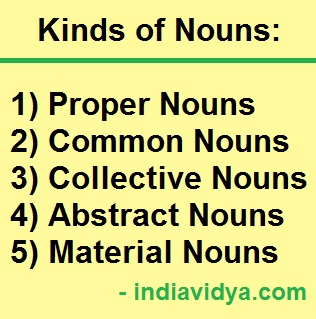
Here Balu, singer, Bengaluru and city are nouns. Since there are many thousands of nouns, experts have divided them into Five groups and they have some striking and distinctive features.

Nouns types

Proper Nouns:

It is a noun used for the name of a particular person, place, or a thing. In the above examples both Balu and Bengaluru are proper nouns.

Features:

1) They usually begin with a capital letter. For example Modi, Prasad, London, Mumbai.
2) We do not generally use Articles with them (Except in some special cases).

Common Nouns:

It is a noun used in general or commonly. We can use them to anybody without any restrictions. For example in place of Balu, we
can say ‘Suneetha is a singer or Geethamadhuri is a singer’ Therefore they are called Common Nouns.

Features:
1) Most of Them have both singular and plural forms. For example, boy – boys, book – books, teacher – teachers.
2) We as a rule use Articles with them (except in some special cases).

Collective Nouns:

It is a noun used for a group of persons and a collection of things. For example in the sentence ‘The class is studying grammar’, the word “class” stands for a group of students.

Features:
1) Most of them have both singular and plural forms. For example team – teams, army – armies, pack – packs, family – families.
2) We use Articles with them (except in some special cases).

Abstract Nouns
These are nouns used for our ideas, thoughts, feelings and stages in our life. For example Anger, Hunger, Love, and Knowledge, Childhood, Motherhood, English and Physics. are Abstract nouns. As these nouns stand for ‘Shapeless’ or ‘Formless’ things, we call them “Abstract Nouns”. As the word Motherhood is ‘drawn’ from the common noun, Mother, and the word Childhood is ‘taken’ from the common noun Child, they are called “Abstract” Nouns.

Features:
1) Most of them have only one form. (in journalism some use words like ‘deaths’, ‘moneys’, ‘hungers’).
2) We do not usually use Articles with them (except in some special cases when talking about a particular situation like ‘The health of
the CM is improving’).

Material Nouns

Nouns used for the names of materials are Material Nouns. Gold, Silver, Iron, Copper, and Sugar. Since these materials have a shape and form, we can call them “Concrete Nouns”.

Features:
1) Most of them have only one form.
2) We do not use Articles with them (except in some special cases like in comparisons – ‘The Iron of India is superior to the Iron of
Japan’)

Note: For some grammarians, Nouns are of just two kinds – Concrete Nouns and Abstract Nouns. They put Proper Nouns, Common Nouns, Collective Nouns, and Material Nouns under the ‘Concrete Nouns’ category. In many Competitive exams questions on Nouns often appear. Here are a few examples:

1. Mohan (1)/ always gives me (2)/ some good (3)/ advices (4)/. No error (5).
(Answer 4 as Advice has no plural form)

2. This (1)/ chair (2)/ is made (3)/ of the Iron (4)/ No error (5).
(Answer 4 as no Article is used before a material noun when used in a general sense).

3. My son (1)/ has learnt (2)/ alphabets (3)/ very easily (4)/ No error (5).
(Answer 3 as ‘alphabet’ is used in singular to mean ‘English letters’)

Countable Nouns:

Nouns which have both singular and plural forms are Countable Nouns. Most of our Common Nouns and Collective Nouns are Countable Nouns.

Uncountable Nouns:

Nouns which cannot be counted as 1, 2, 3, are Uncountable Nouns. Most of our Abstract Nouns, and Material Nouns come under this group.

Some Special Points:

1) Some nouns are always plural: Trousers, shorts, ashes, tidings, riches, alms, proceeds, spectacles, scales, annals, stairs, customs, and wages. They usually take a plural verb except words like ‘wages’- “The wages of sin is death” (The Bible). It also
takes a plural verb some times like in the sentence,’Their wages are paid in full’.

2) Some Nouns are always Singular: information, luggage, money, fun, health, luck, staff, poetry, paper, stationery, harm, rubbish, pollution, leisure, conduct.

3) Some Nouns are Plural in form but Singular in meaning: innings, civics, linguistics, news, gallows. and subjects like physics, economics, mathematics.

4) Some Nouns are Singular in form but Plural in meaning: police, infantry, alphabet, cattle, poultry, peasantry, clergy.

5) Some Nouns have only one form but we can use them both as Singular and Plural: head quarters, deer, sheep, means, species, yolk.

A thorough knowledge of nouns helps you a lot in many ways and especially it helps you understand other Parts of Speech easily. And using just nouns, you can write powerful, and excellent sentences. Here are some such sentences:

“I have nothing to offer but blood, toil, tears, and sweat” – Winston Churchill

“Friends, Romans, countrymen, lend me your ears; I come to bury Caesar, not to praise him” – Shakespeare

“The only thing we have to fear is fear itself” – Shakespeare

“Surely goodness and mercy shall follow me all the days of my life” – The Bible

“When beggars die there are no comets seen; The heavens themselves blaze forth the death of princes” – Shakespeare

error: Content is protected !!