Following are important question and answers for 10th Class students of AP and Telangana from Social Studies. The questions and answers are framed in CCE pattern and useful for SSC public exams of both the states. The Question and Answers are from India – Relief Features chapter of Social Studies.
Q: Which range of Himalayas you cross first when you travel from China to India through the Himalaya?
A: We cross the Himadri range (Greater Himalayas) first when travel from China to India.
Q: How can Indira Gandhi Canal useful in Rajasthan?
A: It supplies water to Thar Desert in Rajasthan. Hence several hectares of desert land have been brought under cultivation.
Q: Why we often use the word Indian Peninsula when refer to India?
A: A Peninsula is a piece of land that is surrounded by water on three sides but connected to main land. India is bordered by three seas on three sides so as we often use the word Indian Peninsula to
India.
Q: Mention the names of the Shivaliks in different regions.
A: The Shivaliks are called as Jammu hills in Jammu region, Mishmi hills in Arunachal Pradesh and Cachar in Assom.
Q: Why did cut forest and converted into the agriculture land in Terrai region?
A: Terai region had thick forest and rich variety
of wild life. However, owing to migrations at the time of India’s partition, most of the Terai zone has now been cleared and used for agricultural operations.
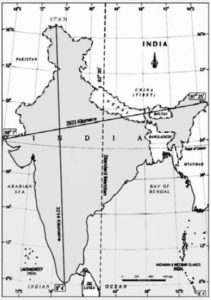
Q: Expand: IST & GMT.
A: IST: Indian Standard Time.
GST: Greenwich Mean Time.
Q: What is Dun? Give examples.
A: The valleys lying between the lesser Himalayas and Shivalik ranges are called Duns.
Q: Arrange the following Peaks in a descending order:
Dodabetta, Everest, Aroyakonda, Anaimudi.
A: (i) Everest (ii) Anaimudi (iii) Dodabetta (iv) Aroyakonda.
Q: What is the remarkable feature of the Peninsula Plateau?
A: The remarkable feature of the Peninsula Plateau is black soils formed due to volcanic activity.
2 Marks Questions:
Q: Write a short – note on “Islands in India”.
A: There are two groups of Islands in India – Andaman and Nicobar Islands stretched in Bay of Bengal and Lakshadweep
Islands in the Arabian sea.
Andaman and Nicobar Islands are an elevated portion of submerged mountain parts running from Myanmar mountain Arkan Yoma. Lakshadweep Islands are of coral region. Lakshadweep is famous for great variety of flora and fauna.
Q: “India is a country of physical diversity” Comment.
A: India is a land of diversified landforms with different types of mountains, hill areas, plains, plateaus, deltas, forests, rivers, valleys etc. Some areas are irrigated by the Himalayan rivers and some are by Peninsula rivers. Many places are located in the river valleys and others in the mountains. South India is Peninsula and north India is bordered by the Himalayas and dense forests, Thar Desert.