IPE Overall Strategy: The total syllabus of 1st year can be divided into 3 parts. First, the student has to concentrate on Long Answer Questions (LAQ) i.e. Section-C of question paper. We can expect one question from each part of above 3 parts.
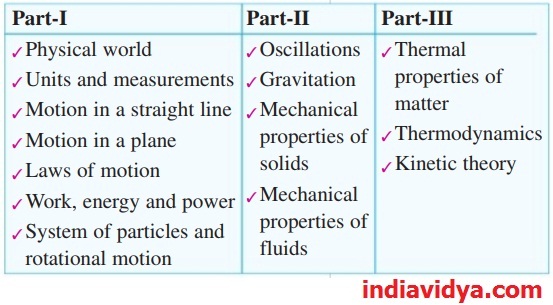
From part 1, the important questions may be like..
i) State and prove conservation of energy
ii) Newton’s laws and their applications
iii) Conservation of Angular momentum and linear momentum.
From part 2, the important questions may be like..
i) Time period simple pendulum derivation
ii) Gravitational potential energy, variation of g, determination of universal gravitational constant G
iii) Determination of Young’s modulus, Bernoulli’s theorem, Viscosity.
From part 3,
i) Newton’s laws of cooling
ii) Carnot Engine & refrigerator
iii) Pressure of an ideal gas.
Also Read: NEET Physics Model Questions with Answers
Junior Inter IPE Model Paper – Physics Paper 1
Important Long Answer Questions
PART – I
1) a) State newton’s second law of motion. Hence derive the equation of motion F = ma from it.
b) A body is moving along a circular path such that its speed always remains constant. Should there be a force acting on the body?
2) Define angle of friction and angle of repose. Show that angle of friction is equal to angle of repose for a rough inclined plane. A block of repose for a rough inclined plane. A block of mass 4
kg is resting on a rough horizontal plane and is about to move when a horizontal force of 30 N is applied on it. If g = 10 ms−2. Find the total contact force exerted by the plane on the block.
3) Develop the notions of work and kinetic energy and show that it leads to work-energy theorem.
4) What are collisions? Explain the possible types of collisions? Develop the theory of one dimensional elastic collision.
5) State the law of conservation of energy and verify it in case of a freely falling body. What are the conditions under which the law of conservation of energy is applicable?
6) a) State and prove parallel axes theorem.
b) For a thin flat circular disk, the radius of gyration about a
diameter as axis is k. If the disk is cut along a diameter AB as shown in to two equal pieces, then find the radius of gyration of each piece about AB.
7) a) State and prove perpendicular axes theorem.
b) If a thin circular ring and a thin flat circular disk of same mass have same moment of inertia about their respective diameters as axes. Then find the ratio of their radii.
8) State and prove the principle of conservation of angular momentum. Explain the principle of conservation of angular momentum with examples.
PART – II
1) Define simple harmonic motion. Show that the motion of (point) projection of a particle performing uniform circular motion, on any diameter, is simple harmonic.
2) Show that the motion of a simple pendulum is simple harmonic and
hence derive an equation for its time period. What is seconds pendulum?
3) State Bernoulli’s principle. From conservation of energy in a fluid flow through a tube, arrive at Bernoulli’s equation. Give an application of Bernoulli’s theorem.
4) Define coefficient of viscosity. Explain Stoke’s law and explain the conditions under which a rain drop attains terminal velocity ‘v1’. Give the expression for ‘v1’.
PART – III
1) State Boyle’s law and Charle’s law. Hence, derive ideal gas equation. Which of the two laws is better for the purpose of thermometry and why?
2) Explain thermal conductivity and coefficient of thermal conductivity. A copper bar of thermal conductivity 401 W/mK has one end at 104°C and the other end at 24°C. The length of the bar is 0.10 m and the cross-sectional area is 1.0×10⁻⁶ m2. What is the rate of heat conduction, along the bar?
3) State and explain Newton’s law of cooling. State the conditions under which Newton’s law of cooling is applicable. A body cools down from 60°C to 50°C in 5 minutes and to 40°C in another 8 minutes. Find the temperature of the surroundings.
4) Explain reversible and irreversible processes. Describe the working of Cornot engine. Obtain an expression for the efficiency.
5) State second law of thermodynamics. How is heat engine different from a refrigerator?
6) Derive an expression for the pressure of an ideal gas in a container from Kinetic Theory and hence give Kinetic Interpretation of Temperature.