AP TET English Content Paper 2 Important Questions and Answers

Here is a passage for APTET English candidates. Read the following passage and answer the given questions accordingly. The Passage is useful for APTET English Content paper 2:
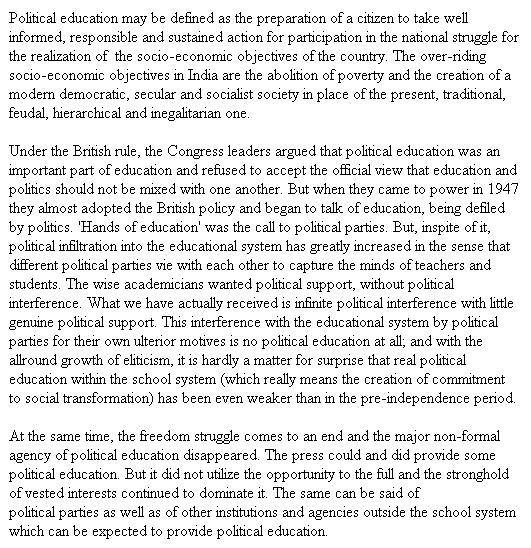
passage for APTET

1. According to the passage, political education in the real sense should prepare
a) citizens for social change.
b) well-informed politicians.
c) responsible students of political science.
d) devoted social workers.

2. The theme of the passage could be:
a) British rule in India and Education
b) Education and Politics
c) Education for Freedom
d) Leadership and Education

3. The author emphasizes in the passage that
a) non-formal agencies of political education do not exist in India.
b) vested interests dominate politics.
c) real political education is lacking in India.
d) the Britishers were opposed to real political education.

4. The author condemns the
a) role of the Britishers in organizing education in India.
b) role of the Congress in politics after independence.
c) political interference in education in India.
d) role of the Press in political education.

5. All teachers agree (1) / that Revanth is the (2) / more intelligent of all the boys in his class. (3) / No error (4)
One of the parts in the above sentence may not be acceptable in standard written communication. Mark that part as your answer.
a) (1) b) (2) c) (3) d) (4)

6. ARROGANT Pick up the right synonym.
a) HAUGHTY b) HOSTILITY c) PROPITIATION d) PERPLEXITY

7. AWKWARD
Locate the apt antonym.
a) CLOWNISH b) SHOCKING c) DREADFUL d) SOLEMN

8. The accountant soon picked up the everyday routine of the department. Label one of the following words to be adjective in the context of the above sentence
a) soon b) the c) routine d) everyday

9. A speech made by someone for the first time Trace the one word substitute that satisfies the above expression.
a) SPONTANEITY b) EXTEMPORE c) MAIDEN d) SERMON

10. to strain every nerve Find the meaning of the above idiom
among the following.
a) to spoil relationship b) to get afraid
c) to try one’s utmost d) to take ill

11. Our government is trying to ………. the economic reforms at the moment Select the appropriate phrasal verb to fill in the blank.
a) carry out b) carry away
c) carry forward d) carry through

12. Choose the word from the following with the right spelling.
a) privilege b) managable c) maintinance d) athlet

13. In the following questions, the first and the last parts of
the sentence are numbered 1 and 6. The remaining parts P, Q, R and S are not in their proper order. Select from the answer choices provided, under the question, the combinations to make a meaningful and correct sentence.
1) The advantage of travelling
P) customs and manners is that
Q) we learn to appreciate the good points of others
R) to different places and having
S) the opportunity of observing people’s
6) and our prejudices against them disappear.
a) QRSP b) PQRS c) RSPQ d) SPQR

14. I must hold a discussion ………. you ………. that matter
shortly.
Choose the correct set of prepositions as demanded by the above sentence.
a) about, for b) with, for c) about, in d) with, about

15. Select the error-free sentence from the following.
a) I want you to meet him.
b) I suggest you to apply for the post.
c) He enjoys to swim.
d) She requested for my help.

16. I saw him go out.
Identify the structure pattern of the above sentence.
a) Subject + Verb + Noun/Pronoun + Plain Infinitive
b) Subject + Verb + Noun/Pronoun + Infinitive
c) Subject + Verb + Object + Present Participle
d) Subject + Verb + Noun/Pronoun + (to be+) Complement

17. Wait a minute, ……….? Add the right question tag.
a) can you? b) can’t you? c) do you? d) don’t you?

18. Choose the right subscription suitable for a formal letter.
a) Yours faithfully, b) Yours Faithfully,
c) Your’s faithfully, d) Yours’ faithfully,

19. Choose the Adverb+Verb type compound word from the following.
a) white wash b) upset c) outspoken d) drawback

20. Tennyson is not the greatest of all poets.
Find the Positive Degree form of the above sentence.
a) Some poets are at least as great as Tennyson.
b) Some poets are not as great as Tennyson.
c) Some poets are greater than Tennyson.
d) None of the above.

21. He stays in ………. bed till nine every morning.
Fill in the blank with suitable article, if necessary.
a) a b) an c) the d) zero article

22. Are you there? Decide the mood of the above sentence.
a) Indicative Mood
b) Imperative Mood
c) Subjunctive Mood
d) None of the above three.

23. He asked why I came. The above sentence is ……….
a) simple sentence.
b) compound sentence.
c) complex sentence.
d) compound-complex sentence.

24. His means ………. (be) simple.
Choose the correct verb form to fill in the blank.
a) is b) are c) be d) was

ANSWERS : 1)a 2)b 3)c 4)c 5)c 6)a 7)a 8)d 9)c 10)c 11) a 12)a 13)c 14)d 15)a 16)a 17)a 18)a 19)b 20)a 21)d 22)a 23)c 24)b.

Teachers Eligibility Test (TET) English Pedagogy Study Material

Approaches of Teaching English
An approach is a set of correlative assumptions dealing with the nature of language teaching and learning” – Edward Anthony
An approach refers to the actual nature of the language. It describes the kind of subject matter to be taught and how best do pupils learn It. It states a point of view, a philosophy or an assumption which one believes but can not necessarily prove.
The main approaches used in teaching English are Structural- Oral- Situational Approach (S-O-S) and Communicative Approach.

The Structural- Oral- Situational Approach
Historical Background: This approach is other wise known as ‘S-O-S’ Approach. It is believed to be an alternative to the direct method of teaching English. This approach is an outcome of the experiments
carried out in language teaching in the army camps in World War-II.

Charles Fries, the director of first English language institute in the USA applied structural linguistic principles to teaching of language and developed structural approach. For Charles Fries
grammar of structure was the starting point in teaching language.

Similarly, the British linguists evolved the oral approach to teaching of English. They believed that a structure or word should not be presented in isolation. It has to be introduced and practiced
in context. Situationally, Harold Palmer and A.S. Hornby were the two most important advocates of this approach.

Distinctive Features of S-O-S Approach
The structural Approach to English is teaching the learner certain structures in a certain order. – C.S.Bhandari

A) AIM: Presentation and practice of carefully selected and graded structures is the motto of structural approach.

B) Unit of Teaching: Structure is the unit of teaching. According to ML Tickoo in learning foreign language mastery of structure is more important than acquiring vocabulary.

C) Syllabus: i) About 250-300 carefully selected and graded structures
ii) 2500-3000 words (Vocabulary)

D) Selection of Structures: i) Useful to pupils (utility oriented): The structures which frequently occur in both spoken and written
language should be selected.
e.g.: The verb ‘have’ has more than one meaning.
I have two hands.
She has a Car.
India have won the world cup.
ii) Simple and easily comprehendible (simplicity): Simple structures like…I am walking, you are playing – can be selected for the asier understanding of the pupils.
iii) Easily teachable and learnt(Teachability): The teachable structures should be selected and taught in the beginning. For example ‘I am standing’ is an easy structure when compared to ‘I am honest (or) I am thinking’
iv) Yield results (productivity): The structures selected should be productive. It means that one structure should be able to produce more structures. For example ‘I drink milk’ is a productive structure with which we can connect more links such as you drink… they drink…, we drink…

E) Procedure of teaching: In S-O-S approach every structure is taught separately.
Generally the following five steps are involved:
i) Presentation of structure in appropriate situation by the teacher
ii) Oral drill by the students of the situations created in step-I
iii) Presentation of item/structure in some new situation
iv) Oral drill by the students of situations created in step-III
v) Over all drill

F) Language Perception:
i) Language is primarily speech. So oral work plays a vital role
ii) Language is a set of habits. So language drills take a vital position. Use of drill is the central technique here.

G) Adoption of other approaches: Structural approach goes with situational approach. Structural approach in India The structural approach made its advent in India in 1952.
Tamilnadu was the first state in India to agree to use S-O-S approach.
The British Council helped the Tamilnadu Government in framing the structural syllabus and producing necessary materials.
Advantages : 1. Structural approach gives importance to speech or oral aspect of the language which enables the learner to acquire fluency.
2. Habits of correct pronunciation of English words are developed because of its emphasis on oral practice.
3. Structures are grasped permanently as result of repeated use by
the students.
4. Drills and repetition minimise the mistakes.
5. As situational teaching is the hall mark of this approach, students learn the language in meaningful situations. This could help them to perform better in the life situations

Limitations/Disadvantages : 1. This approach suits lower classes.
The students of higher classes dislike monotonous drills. They take the drills as fun.
2. Situations either real or contrived (artificial) can not be created for each and every structure.
3. Complete knowledge of grammar can not be obtained.
4. It is time consuming approach.
5. It does not suit to the over crowded classes. This is not helpful in teaching poetry, descriptive and narrative writing.

Key points of the topic
1. An approach deals with the nature of language.
2. S-O-S Approach came into practise as an alternative to direct method.
3. Charles Fries developed structural approach in the USA.
4. According to Fries structure should be the starting point in Language teaching.
5. Harold Palmer and A.S. Hornby were the two British linguists evolved oral approach. They said that the structure should be introduced and practiced in a meaningful context.
6. Practising selected structures in a meaningful context is the distinctive feature of this approach.
7. S-O-S approach gives prominence to oral work and intensive drills.
8. S-O-S suits lower classes.
9. Situations can not be created for the teaching of each and every structure.
10. This approach is least effective in teaching poetry, descriptive and narrative writing.

1. The hallmark of structural approach is ……….
1) forming speech habits
2) mastery of selected structures in meaningful situations.
3) memorisation of vocabulary
4) repetition and drills

2. The structural approach is an alternative to ……….
1) Bilingual method
2) Grammar-Translation method
3) Direct method 4) Reading method

3. Something that deals with the nature of language is ……….
1) a technique 2) an approach 3) a method 4) a strategy

4. Contextual and situational practice of structures was proposed by……….
1) Charles Fries 2) Hornby 3) Michael West 4) C.J. Dodson

5. Selecting frequently occurred structures in S-O-S approach denotes ……….
1) The utility oriented aspect
2) The simplicity principle
3) The productive oriented aim
4) The easily teachable feature

6. The technique used in structural approach is……….
1) Questioning 2) Drilling 3) Brain storming 4) Memorisation

ANSWERS: 1)2 2)3 3)2 4)2 5)1 6)2 .

error: Content is protected !!